 One of my cousins turned sixty just the other day.
She held a small party at a lodge with only close family and a few friends present. It was an evening of joy and fun, with the ‘Seventies’ as theme. We were honoured to be present.
We danced like in the olden days when disco’s like Orbitique, Grand Wazoo, and others kept young people off the streets.
My cousin’s late brother and I were almost inseparable and quite some disco jollers. We had a couple of great moves which developed from our interaction with the farm workers’ boys on my uncle’s farm near Thabazimbi as young boys ourselves.
Music eliminated our language barrier.
 I remember boys like Salthea, whose father worked for my uncle. Music eliminated our language barrier. My cousin and I were taught to dance properly on Kwaito music. Not the famous Mandela shuffle, but real township style dancing. We could dance township-style long before Sipho ‘Hotsticks’ Mabusa or Mandoza with his Nkalakatha became the in-thing on dance floors.
I still like to throw a few moves at wedding receptions, especially when my son is also present. I taught him well and he is also fond of good indigenous music, or any good dancing music, for that matter.
My late cousin and I later enjoyed employing the dance skills we developed, unfortunately not understanding the language, but through music, the lyrics of which we did not understand a word of. Neither of us had working knowledge of any of the indigenous languages, except for a few Sepedi words.
I was always intrigued watching him speak to black people in their mother tongue during a time when black people were supposed to rather speak Afrikaans to him.
 My maternal grandfather was somewhat of a ‘korrelkop’. He adored me, but not everyone was fond of him. He could at times be quite ‘ongeskik’. He used to be a court interpreter for a time in his life, being proficient in Sesotho. I was always intrigued watching him speak to black people in their mother tongue during a time when black people were supposed to rather speak Afrikaans to him.
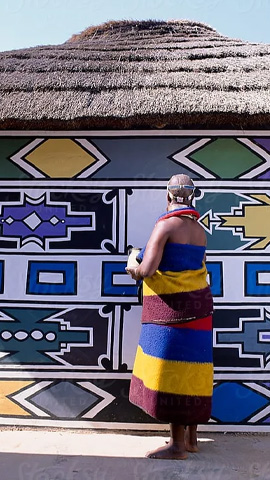
Our domestic helper, Lettie, was from the Ndebele tribe. We did not learn much of the Nguni languages from her, except when we crossed the line from time to time. Then she would warn us by a “beta wena”, meaning “you better watch out”. She might also have sent us off with a “hamba”, meaning “go”.
The only other person in our household who I know was able to, sort of, talk an indigenous language was my father. He could help himself in Fanagalo. It is a South African pidgin language developed primarily on the mines. It is based on Zulu with influences of Afrikaans, English and other African languages and enabled miners from different backgrounds to communicate.
It is encouraging to see how people react when you greet them in their own language. It is as if someone feel acknowledged by such a small gesture.
 Instead of learning Sepedi as a school subject, I rather chose German, probably under the influence of my mother. My use for the little knowledge of that language is limited to the few times when we were on an overseas trip in a German speaking country. Not really worth the effort when I could have rather learned to speak a language indigenous to my place of birth.
In the early nineties I unsuccessfully tried to remedy this shortcoming by enrolling in a course in Setswana with UNISA. Unfortunately, it was a mistake, as it was presented in an academical manner. I did not follow through. I kept on making the same mistake by buying courses from providers that are much too academic in their approach.
My sparse knowledge of the Nguni language and Sepedi, however, still kept me wanting more. It is encouraging to see how people react when you greet them in their own language. It is as if someone feel acknowledged by such a small gesture.
It has, on occasion, saved my skin when stopped by a police official after probably having one too many. My “Thobela Morena”, and then after he enquired about my wellbeing responding with a “rena re gona le na lekae”, gave me a wave through and a safe passage home.
While sitting for some time and once again realising how uncomprehensive it is to not understand your fellow citizens.
Last week I decided to head to the nearest Home Affairs office and apply for an identity card. I was one of only three people who were obviously not able to speak an indigenous language. I was not sure if I was sitting in the correct queue despite the helpdesk official directing me in the right direction.
Once again, I felt myself falling short of even a basic understanding of what was said on over the intercom. While sitting for some time and once again realising how uncomprehensive it is to not understand your fellow citizens. I recalled a conversation with two of my cousin’s children. One of them was learning Italian with the Duolingo app, the other one Spanish. They explained how easy the learning is using this app and there and then I decided to give IsiZulu another chance.
I am now on day seven and going strong. Wish me well.
Hamba kahle.